
RAG Part II: Why Basic RAG Fails (And How Hybrid RAG Fixes It)
Table of Contents
Why Basic RAG Fails (And How Hybrid RAG Fixes It)
In Part I, we talked about "Naive RAG" and why it often retrieves the wrong data. It's like using a simple Ctrl+F search—it misses context.
Today, let's look at the solution: Advanced RAG with Hybrid Search.
The engineering goal here is reliability. We move from just "searching" to actually "understanding."
The Core Concept: Hybrid Search
Naive RAG usually relies on Vector Search (finding similar meanings). Hybrid RAG combines Vector Search with Keyword Search (finding exact words).
Here are the use cases where this combination is critical:
1. The "Exact Match" Use Case
Imagine an engineer searches for a specific error code like "Error 505-B."
- Vector Search might fail here. It might return "Error 505-A" because the numbers look mathematically similar in the vector space.
- Keyword Search saves the day. It forces the system to look for that exact text string.
2. The "Vague Concept" Use Case
Imagine a customer asks, "Why is the device hot?"
- Keyword Search might fail if the manual uses the word "Overheating" instead of "hot." They don't match.
- Vector Search wins here. It understands that "hot" and "overheating" mean the same thing conceptually.
3. The "Noise" Use Case
Sometimes you get too many results. This architecture adds a Reranker (the step on the right). It acts like a strict editor. It reads the top 50 results and throws away the 45 that are irrelevant, passing only the best 5 to the LLM.
The Best of Both Worlds
By using both methods plus a final quality check, we get the best of both worlds:
- Precision from keyword matching
- Recall from semantic understanding
- Quality control from reranking
Stay tuned for Part III, where we will discuss the next frontier: Modular and Agentic RAG.
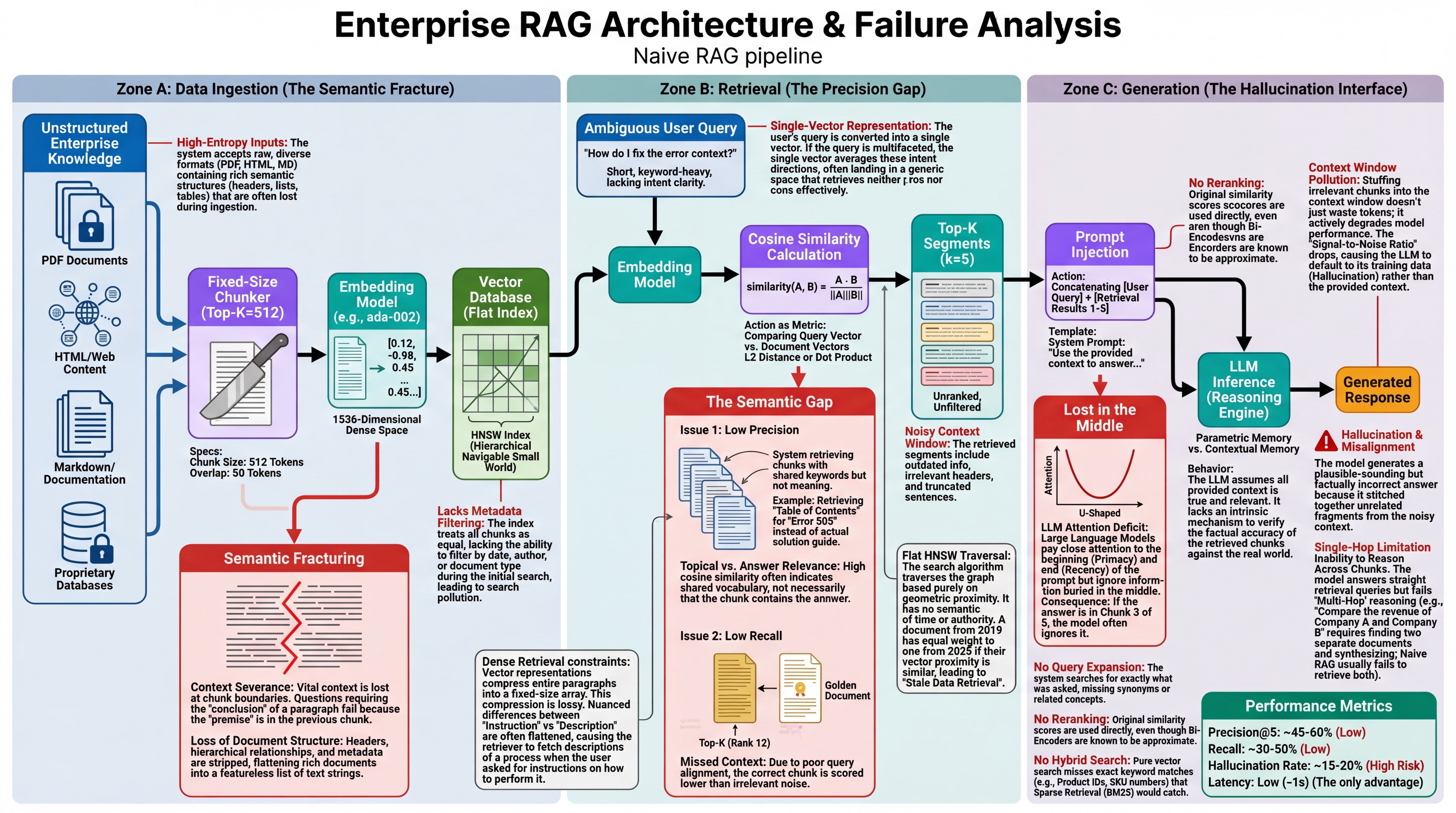
RAG part I: Why Your RAG System Keeps Giving Wrong Answers
Exploring why naive RAG implementations fail and how the semantic fracture, precision gap, and hallucination interface degrade performance.